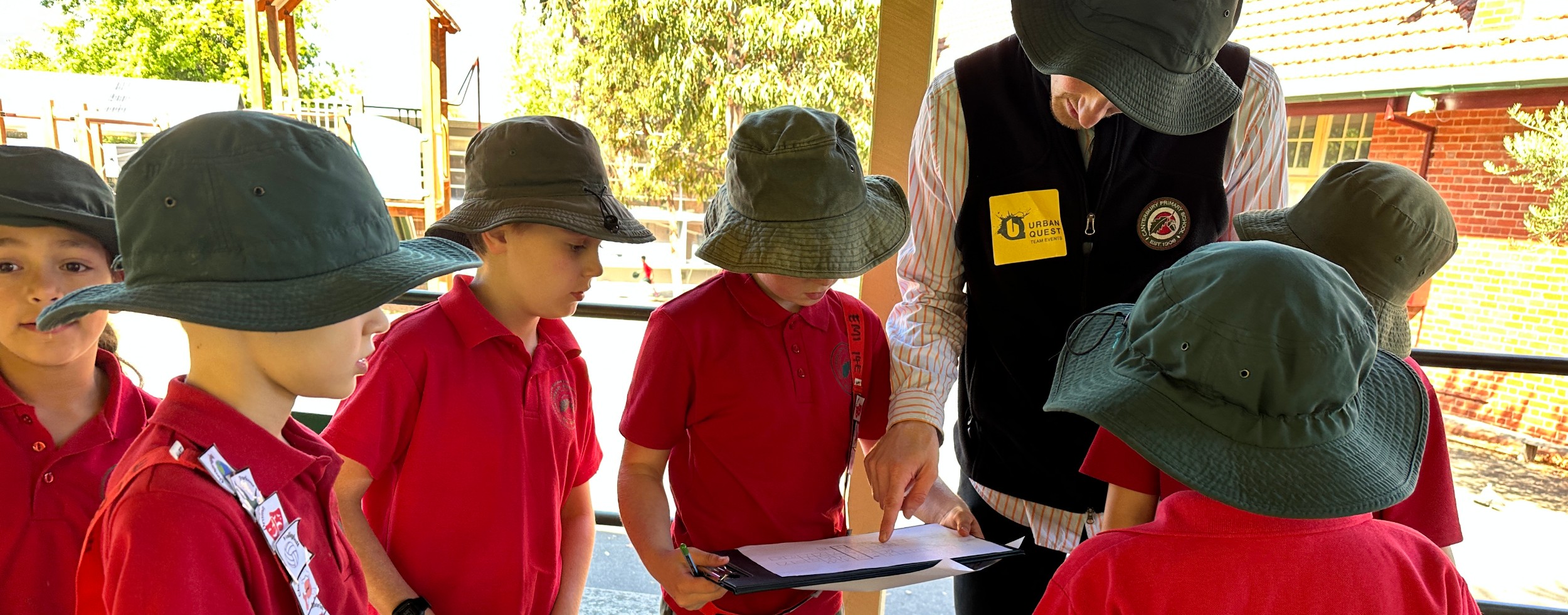
Canterbury Primary School‘s Year 4 class had been working toward something all term. Callum Urquhart, their Grade 4 teacher, had built a project around identifying and celebrating what students were good at — and giving them structured opportunities to improve what they weren’t. They called it the Level Up project.
Students earned badges throughout the term by completing tasks, developing skills, and demonstrating growth. The Urban Quest school incursion was the final badge. The big prize at the end of the journey.
The Level Up Project — Why Urban Quest Fitted Perfectly
The Level Up project wasn’t looking for a fun afternoon. It was looking for an experience that genuinely tested the skills students had been developing — teamwork, collaboration, problem-solving, working respectfully with different people — in a context where those skills mattered and where the outcome was real.
“We really wanted to focus on things like teamwork, collaboration, being respectful within a team environment, working with different people, problem solving — and Urban Quest is absolutely perfect for that sort of stuff.”
The fit wasn’t incidental. Callum had already run an Urban Quest event the previous year with his Year 6 class and seen what it produced. The decision to bring it into the Level Up project was deliberate — the experience he’d observed with older students translated directly to what the Year 4 cohort needed as their culminating challenge.
“Just looking around today at all the groups running around — they’re working with different people, they’re problem solving, they’re being kind and respectful to each other. It’s just everything that we wanted out of today.”
How Canterbury Primary Chose Urban Quest
The decision came from two sources: Callum’s own prior experience and word of mouth from other teachers.
“We chose Urban Quest just from our past experiences and word of mouth — talking to other teachers who had done Urban Quest in different year levels. They spoke really highly of the program.”
That teacher-to-teacher recommendation pattern is one of the most reliable signals in the school incursion market. Teachers don’t recommend activities that produced a mediocre day — they recommend the ones that had students buzzing and that made their job easier rather than harder. Canterbury Primary had both reasons: direct experience and peer confirmation.
What Made the Process Work
Callum was specific about what made the organisation experience stand out — not just the event itself, but the process of getting there.
“It’s a really seamless process. We got in touch early on, worked out what dates were going to work, and then just through emails we worked out the times that were going to suit us as a school and work for our timetabling.”
The customisation detail matters particularly — Canterbury Primary worked with Urban Quest to incorporate a puzzle as part of their specific Level Up project outcome. That kind of tailoring to a school’s existing pedagogical context isn’t something every incursion provider offers or accommodates.
“We talked about what the end result of the day was going to be — and we had a little puzzle that we put together. Then we had a really clear list sent by Urban Quest of what we needed to do on our end to prepare for the day to make sure it ran really smoothly. It was a really simple list to tick off.”
The clear preparation list is something Callum returned to specifically — a direct acknowledgement that teachers are busy and that any incursion that adds to their workload rather than reducing it is an incursion they won’t book again.
“The communication’s always really fantastic, which makes our job as teachers — we’re very busy — but it just makes our job a little bit easier as well, which we really appreciate.”
What the Students Experienced
Urban Quest incursions work for Canterbury Primary because they create genuine independence — something Callum identified as both rare and valuable.
“They have an absolute ball from start to finish. You can’t wipe the smiles off their faces. But it’s just the opportunity to have a bit of independence — working in groups and being able to go off and achieve little tasks together and problem-solve together without teacher support.”
“When we can’t see them and they are all around the school completing these tasks — it really is on them to follow the instructions, to problem-solve as a group, and to work together to be successful. That’s a really fantastic part of the Urban Quest experience.”
That observation — “it really is on them” — captures something that is hard to create in a classroom setting. Teachers can encourage independence, but the structure of the classroom rarely demands it in the same way. An Urban Quest incursion, where teams are genuinely unsupervised across the school grounds, creates conditions where independence isn’t optional. Students who might default to waiting for teacher guidance in the classroom discover that they can navigate a challenge without it.
Why Canterbury Primary Recommends It to Other Schools
Callum’s approach to sharing the experience with colleagues is instructive — he doesn’t wait to be asked.
“Through word of mouth, we’ll always share with other classrooms and other teachers around the school the experience we’ve had. And then networking with other schools — it’s definitely something that we do like to discuss.”
“Incursions that get students buzzing and talking about for the rest of the year are the sort of incursions that we want to continue. And that’s certainly our experience in the past from Urban Quest.”
An incursion that students are still talking about months later — that’s the standard Callum is applying. Urban Quest met it. That’s why Canterbury Primary keeps coming back, and why Callum keeps recommending it to his colleagues.
Explore Urban Quest’s school incursions →
Read what teachers look for in a school incursion →
Contact Urban Quest for a school incursion proposal →
Canterbury Primary School is one of hundreds of Melbourne primary schools that have run Urban Quest on-campus incursions. Other schools include Somerville Primary, Ashburton Primary, Pinewood Primary, Auburn Primary, and South Melbourne Primary.