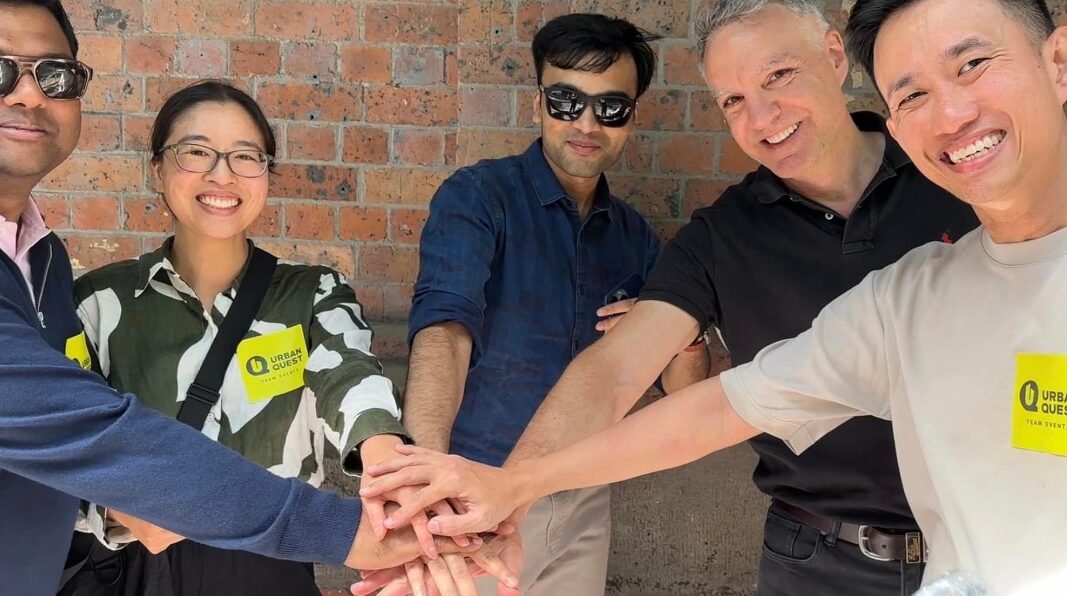
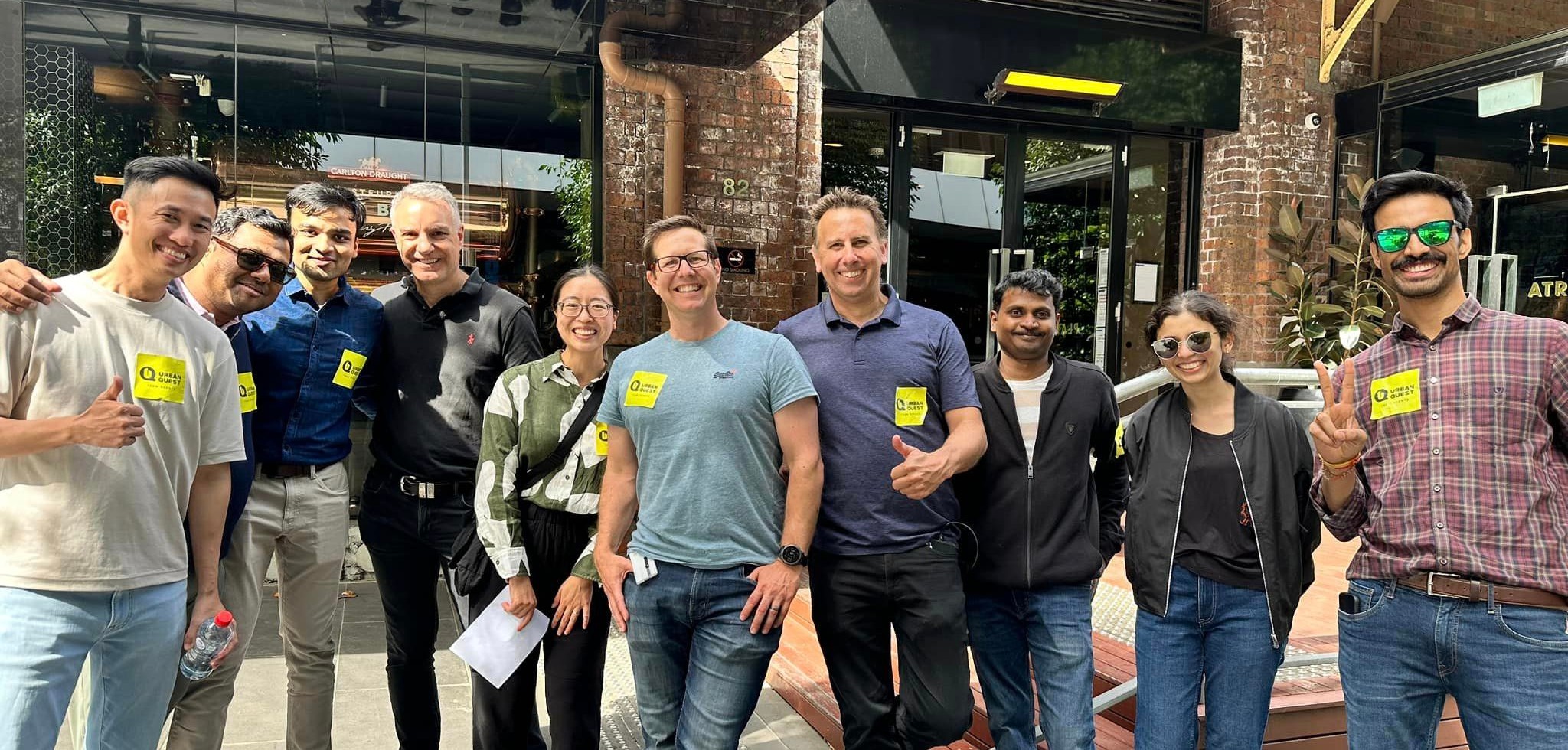
James Buckingham is the Select Stage Manager at ExxonMobil. When he needed to bring together a cross-functional team spread across Singapore, India, and Australia for a day of team building in Melbourne, he chose Urban Quest’s Questbusters Docklands experience — and not for the first time.
“We’ve used Urban Quest before. They’re a lot of fun and well organised. Very easy, very responsive. They set it up well.”
The Docklands location was a deliberate choice — convenient to ExxonMobil’s Melbourne office and a setting that several team members had worked near for years without properly exploring.
The Brief — A Global Team in One Place
ExxonMobil’s cross-functional teams don’t often share the same physical space. The people in this group came from different countries, different disciplines, and different working cultures. James’s goal was specific:
“We had a team spread out around the world — it was a chance to get them all together and build the team.”
The Docklands waterfront format — teams navigating the area together, problem-solving under competitive time pressure — provides exactly the right conditions for that kind of integration. Not a meeting, not a workshop, but a shared physical experience that requires genuine interaction and produces genuine discovery.
James’s verdict on the day:
“The Docklands experience was great. Great to get to experience somewhere we hadn’t really been much before. A lot of fun — good mixture of problem solving but also a bit of moving around and getting outside.”
What the Players Observed
The players’ account of the same afternoon is one of the most thoughtful post-event reflections we’ve captured from any Urban Quest group. The team came from Singapore, India, and across Australia — a cross-functional group with genuinely different professional backgrounds and cognitive approaches.
Their first observation was about discovering Melbourne through fresh eyes:
“You walk around these streets and you never notice all these things until you actually stop and do something like this. I’ve never seen those things, but I’ve walked past them many times.”
The familiar-made-unfamiliar dynamic is something Urban Quest’s challenge design produces deliberately. Clues are embedded in real locations that many participants have passed without noticing. The act of stopping to look, properly, at a place you’ve walked past hundreds of times is itself a small but genuine shift in attention — the same shift that makes a cross-functional team start noticing each other’s capabilities.
“Same Information, Seen Differently”
The most analytically precise observation came from the team’s reflection on how different people approached identical challenges:
“Everyone had the same information. But based on their understanding or knowledge, they could add to it. We all saw it differently — same information, everyone kind of saw it differently.”
“Each of us had very different strengths. It just came together — everyone was getting different parts of the problem. That was entertaining.”
This is the mechanism that makes diverse teams genuinely outperform homogeneous ones — not in spite of seeing things differently, but because of it. A challenge that looks one way to an engineer from Singapore looks another way to an operations manager from India and another way to an analyst from Brisbane. When those three perspectives are applied simultaneously to the same problem, the team reaches solutions faster than any individual could.
“Play Time to Break the Barrier”
The player observation that best captures what team building actually produces — beyond the fun, beyond the specific skills — was this:
“You interact and solve problems in a fun environment. You get a sense for how people like to solve problems. And then in a work environment, it’s obviously a whole lot more serious — but you already have that relationship, that environment that encourages sharing of ideas and bringing diverse perspectives to problem solving.”
“Without that kind of play time to figure it out to begin with, sometimes it’s really hard to break the barrier.”
That phrase — play time to break the barrier — is the most concise articulation of why team building precedes performance that we’ve heard from any Urban Quest participant. The barrier isn’t hostility or conflict. It’s the professional caution that makes people in unfamiliar cross-functional teams wait to be asked rather than volunteer, hold back ideas rather than risk being wrong, defer to seniority rather than contribute expertise. Urban Quest’s competitive format dissolves that caution in an afternoon.
“Don’t assume that good ideas can only come from certain people. Don’t always think you know what to do.”
ExxonMobil and Urban Quest — A Repeat Relationship
James’s closing observation reflects the considered judgment of someone who has been through the experience multiple times with different ExxonMobil cohorts:
“I’d probably do a different one next time — a different challenge — but yeah, do it again.”
That combination — intent to return, preference for a different format next time — is exactly the repeat booking pattern Urban Quest is designed to support. The Ocean’s Eleven CBD route, the Questbusters Docklands route, the Black Friday indoor format, and the custom True Detective on-site experience each produce a genuinely different experience for teams who have done one before. ExxonMobil has run multiple Urban Quest events across different cohorts and formats.
Explore Urban Quest’s corporate team building formats →
Read about the Questbusters Docklands experience →
Read what actually changes after a team building event →
James Buckingham is the Select Stage Manager at ExxonMobil. Urban Quest has delivered team building events for ExxonMobil across multiple cohorts and formats including Questbusters Docklands and Ocean’s Eleven CBD.